'The real story of 2025 is that India officially stopped being a 'market of the future' and started acting as the world's primary economic engine.'

China's ruling Communist Party is holding its annual leadership conclave to discuss the new five-year plan, the impact of US President Donald Trump's tariff war, and the ongoing anti-corruption crackdown in the military.
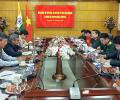
The 15th India-Vietnam Defence Dialogue signalled a move from routine talks to deeper cooperation, with new deals on submarine rescue and defence industry to support stability in the Indo-Pacific, notes Dr Rajaram Panda.

Congress leader Rahul Gandhi alleges the government discourages foreign dignitaries from meeting the Leader of the Opposition due to insecurity, breaking established traditions.

A Chinese diplomat's aggressive comments threatening the Japanese Prime Minister over remarks about Taiwan have ignited a diplomatic row between China and Japan.
Russian President Vladimir Putin on Thursday described the latest United States sanctions as an 'unfriendly move' that would not help relations between Moscow and Washington, DC.

Reaffirming India's stand against terrorism, Prime Minister Narendra Modi has urged leaders of the G7 to galvanise global action against terrorism and underscored the need for strict action against those who 'promote and support' it.

Russian President Vladimir Putin announced his upcoming visit to India in December and expressed his intention to address the trade imbalance between the two countries, particularly concerning India's crude oil imports from Russia. He also lauded India's independent stance on international issues and highlighted the strong relationship between the two nations.
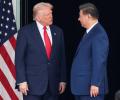
United States President Donald Trump said that China 'knows the consequences' if it attacks Taiwan, asserting that Chinese President Xi Jinping understands the situation 'very well'.

Prime Minister Narendra Modi said he looks forward to useful conversations with his fellow leaders from China, South Africa, Brazil and Russia on addressing pressing international and regional challenges that stand in the way of their goals.

The 2025 US National Security Strategy marks a major pullback, with America turning backward and effectively allowing China greater dominance in Asia. while long-time partners like India are left to face an increasingly unstable global order largely on their own, observes Rajeev Srinivasan.
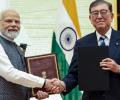
India and Japan have unveiled a comprehensive framework to boost their defence cooperation in response to security challenges, particularly concerning China's increasing military presence in the East and South China Seas.

Prime Minister Narendra Modi and French President Emmanuel Macron discussed the Ukraine conflict and bilateral relations, reaffirming their commitment to global peace and stability.
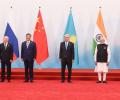
The Shanghai Cooperation Organisation (SCO) strongly condemned the Pahalgam terror attack and concurred with India's position that 'double standards' in the fight against terrorism are unacceptable.

India and Canada have unveiled a roadmap to boost cooperation in trade, critical minerals, and energy, signaling efforts to rebuild strained relations following the killing of a Sikh separatist in 2023. Discussions include addressing concerns over pro-Khalistan elements and pursuing a balanced partnership.

Prime Minister Narendra Modi on Monday presented India's strong stance against terrorism, calling out the 'some countries' for their open support of terrorism and reaffirming that such 'double standards' are not acceptable.
Two senior Chinese ministers attended India's Independence Day reception in Beijing, signaling a potential improvement in relations ahead of Prime Minister Modi's expected visit to China for the Shanghai Cooperation Organisation summit.
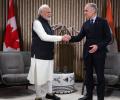
For Canada, important steps towards containing domestic elements that fuel pro-Khalistan sentiments can go a long way in signalling trust positively with regard to security and sovereignty, point out Harsh V Pant and Vivek Mishra.
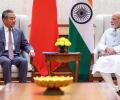
China's Foreign Minister Wang Yi expressed China's anticipation for Prime Minister Narendra Modi's visit to the Shanghai Cooperation Organisation (SCO) summit, emphasizing the importance of strong India-China relations and mutual cooperation.
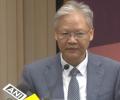
Chinese envoy Xu Feihong stated that China opposes the US imposing tariffs on India, amidst a thaw in Sino-India relations and concerns over global trade disruptions.

Chinese Foreign Minister Wang Yi said that it is imperative for the two sides to view each other as partners and opportunities rather than rivals or threats, and invest their valuable resources in development and revitalisation.
China firmly opposes the Trump administration's 50 percent tariffs on India as it is "unfair and unreasonable" and New Delhi and Beijing should scale up economic ties to jointly counter the challenge, Chinese ambassador Xu Feihong said on Monday.

Kremlin spokesman Dmitry Peskov said the two leaders had a tete-a-tete in the car for about an hour.
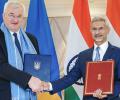
External Affairs Minister S Jaishankar reiterated India's support for an early end to the conflict in Ukraine after a conversation with his Ukrainian counterpart, Andrii Sybiha. The discussion follows recent diplomatic engagements, including meetings between Prime Minister Modi and both President Putin and President Zelenskyy.

India and Russia always stood "shoulder-to-shoulder" even in the most difficult situations, Prime Minister Narendra Modi told Russian President Vladimir Putin on Monday, against the backdrop of possibly the worst phase in New Delhi's ties with the US in over two decades.
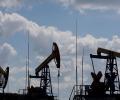
India has voiced regret over the Ukraine conflict's 'collateral consequences', including prices of fuel, saying countries of the Global South have been left to fend for themselves, as Delhi underscored that diplomatic efforts hold the promise to end the war and bring lasting peace.
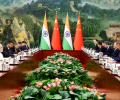
Chinese President Xi Jinping told Prime Minister Narendra Modi that India and China should approach their relations from a "strategic" and "long-term perspective" during their talks in Tianjin. Xi also emphasized upholding multilateralism and working towards a multipolar world.

Lavrov, who addressed the UN General Assembly shortly before External Affairs Minister S Jaishankar's speech at the high-level General Debate, said India and Russia share a "particularly privileged strategic partnership".
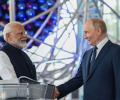
Prime Minister Narendra Modi conveyed to Russian President Vladimir Putin that India is ready to make all possible contributions towards a peaceful resolution of the Ukraine conflict.
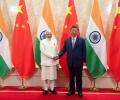
Prime Minister Narendra Modi and Chinese President Xi Jinping held bilateral talks focusing on economic ties and global stability amid trade tensions and the aftermath of the Ladakh border row.

The BRICS nations have expressed concern over the proliferation of trade-restrictive actions in the form of 'indiscriminate rising' of tariffs, particularly measures used as a means of 'coercion', cautioning that such practices risk marginalising the Global South countries.
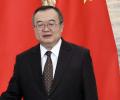
The 61-year-old senior diplomat was taken away for questioning in late July after returning to Beijing from an overseas work trip, the paper reported, quoting people familiar with the matter.

Prime Minister Narendra Modi condemned the violation of Qatar's sovereignty following Israeli air strikes on Doha, targeting Hamas leaders. He conveyed India's deep concern to the Emir of Qatar and reiterated support for peace and stability in the region.

India and China have reached new common understandings agreeing to conduct normalised management and control of the boundary during Foreign Minister Wang Yi's visit to New Delhi, Beijing said.

Prime Minister Narendra Modi is expected to visit Japan and China starting around August 29. The visit to China would be his first after the Ladakh border standoff.

The Bloomberg report suggests that this backchannel communication from President Xi has laid the groundwork for a broader thaw in relations. This overture has since translated into a series of tangible diplomatic actions leading up to the upcoming Shanghai Cooperation Organisation (SCO) summit.

Russian President Vladimir Putin briefed Prime Minister Narendra Modi on his summit talks with US President Donald Trump on ending the war in Ukraine.
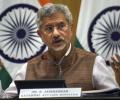
The last Indian external affairs minister to visit Pakistan was Sushma Swaraj. She had travelled to Islamabad in December 2015 to attend a conference on Afghanistan.

Twenty-six foreign leaders, including Vladimir Putin and Kim Jong Un, will attend China's V-Day commemorations on September 3. Japan has expressed concerns about the event's anti-Japanese overtones.
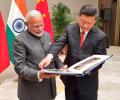
China's foreign ministry on Monday parried questions on a possible meeting between Prime Minister Narendra Modi and President Xi Jinping on the sidelines of the BRICS summit in Russia this week.
 © 2026 Rediff.com - Advertise with us - Disclaimer - Privacy Policy - Sitemap - Feedback - About us - Terms of use - Grievances